


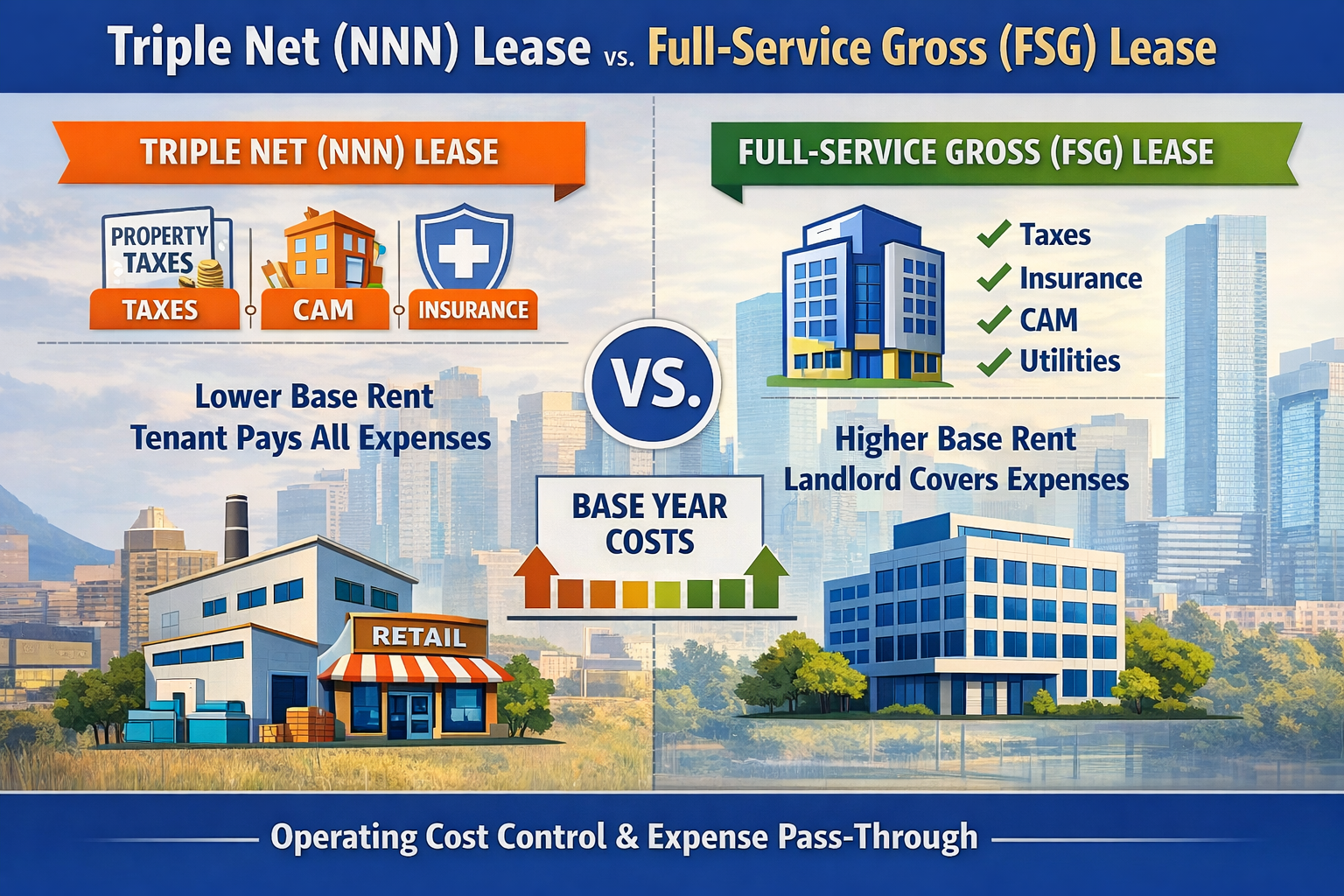
Be careful relying on generalities and assumptions surrounding the nomenclature of your commercial lease. Details matter and that’s why it’s best to have experienced tenant representation and legal counsel guide you and advocate as your fiduciary through the commercial leasing process. For example – a common AI overview explains the difference as follows:
“The primary difference between a Triple Net (NNN) lease and a Full-Service Gross (FSG) lease is who pays for property operating expenses: in an NNN lease, the tenant pays lower base rent plus taxes, insurance, and CAM, while an FSG lease includes all these costs in a higher, all-inclusive rent. FSG is common for office space, while NNN is typical for retail/industrial.
Triple Net (NNN) Lease
- Tenant Costs: Base Rent + Property Taxes + Insurance + Common Area Maintenance (CAM).
- Tenant Risk: Higher, as they are responsible for fluctuations in operating costs.
- Rent Amount: Generally lower base rent per square foot.
- Best For: Long-term, stable, or single-tenant buildings.
Full-Service Gross (FSG) Lease
- Tenant Costs: One all-inclusive rent payment.
- Landlord Costs: Landlord pays all property operating expenses (taxes, insurance, CAM, utilities, janitorial).
- Rent Amount: Higher base rent per square foot.
- Best For: Multi-tenant office buildings.
Key Differences Summary
- Responsibility: NNN shifts operational risk to the tenant; FSG keeps risk with the landlord.
- Budgeting: FSG offers predictable monthly expenses, while NNN costs can fluctuate.
- Expense Pass-Through: In FSG, tenants may only pay for increases in expenses over a “base year”. In NNN, tenants pay all actual costs.”
These items are generally true; however, the vast majority of Full-Service Gross lease structures are based on the Expense Pass-Through over and above a base year stop that is established typically in the year a lease is executed. This Base Year can be negotiated and timing matters – especially if building occupancy has fluctuated considerably, a building sale has occurred, or if there’s a pending assessment year which happens every two years in odd-numbered years here in the state of Colorado. If your base year is artificially low there could be considerable pass-through expenses in years forward with a new building value. The Base Year concept also serves to make the overall cost between a NNN lease and a FSG lease similar in terms of total dollar amount.
There’s also the difference in what is or what is not included in the overall services provided by Landlord and what is thereby included in the Operating Expenses for a given building and how much operational control a tenant may have over their total cost structure. Be sure to discuss your concerns and evaluate your overall future costs with your tenant representation broker. These concepts can be confusing and they have a material impact on the risk and costs associated with your commercial lease.