


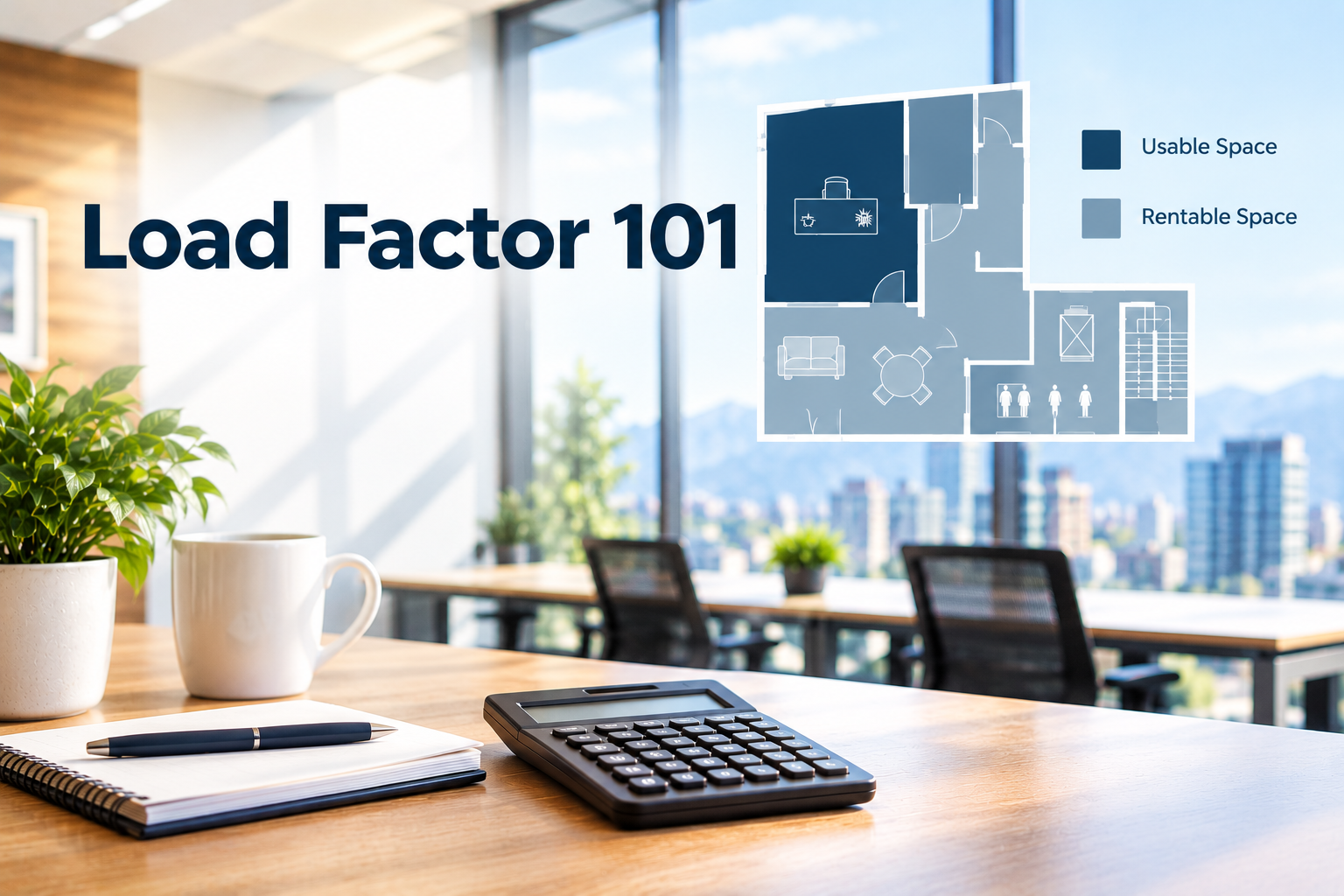
Load Factor 101: The Office Space Math Every Office Tenant Should Know
Have you ever wondered why the office space that you’re paying for seems a little bigger on paper than it feels like in real life? This is because of the “load factor.” In commercial real estate, load factor is the percentage of shared building space allocated to your office in addition to your private, usable space. Think lobbies, hallways, restrooms, elevators, fitness centers, shared conference rooms, and other common areas. In other words, you’re not just leasing your own office space, you’re also paying your pro rata share of the building’s shared spaces.
Here’s how it works: Load Factor = Rentable Square Feet ÷ Usable Square Feet
Let’s say your office has 1,000 usable square feet (USF), but your lease lists 1,150 rentable square feet (RSF). Your load factor is 1.15, or 15%. That extra 150 SF represents your allocated share of the common areas. So, while your team might physically occupy 1,000 SF, your rent is actually calculated on 1,150 SF.
So, why should you care as a tenant? Because load factor directly impacts your costs, your space budget, and how much office you’re actually getting for your money. For example, two buildings offering the same rental rate per square foot on the same usable square foot unit size can have very different total costs if their load factors differ.
It is also good to remember that a higher load factor isn’t necessarily a bad thing. It might mean that a building has fantastic amenities or generous common areas. It may be worth it to you to pay a little bit extra, all else equal, to be a tenant in a building that has a great fitness center, tenant lounge, and a conference room to reserve.
Understanding load factor helps you compare buildings more accurately, negotiate your lease with confidence, and avoid surprises when the rent bill arrives.


